

Social learning
Education changes lives
Myklassroom change the way we educate
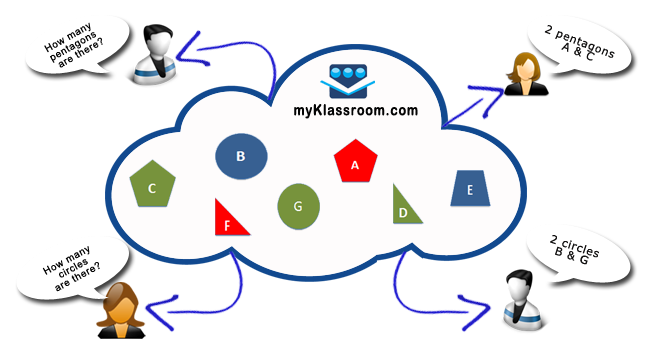
Learning is and has always been a social phenomenon. We learn everyday from things and people around us. As William Butler Yeats said "Education is not the filling a bucket but the lighting of a fire". Today almost everything is globalized and Education is nonetheless under the same radar. Globalization is aimed at providing diverse perspectives on ways in which education is being shaped.
Knowledge is distributed across a network that includes people and objects. To navigate, make sense, and come to understand knowledge, the process of cognition is also distributed across networks, and includes "interactions between people and with resources and materials in the environment".
A decade ago, information was consolidated and packaged into books or instructional material like journals, course etc. Not anymore. Today, the students can acquire Information from varied sources. We take a piece, add to it, reframe or rethink and end up with some pattern that symbolizes the meaning.
The view that students coordinate activity in "interaction, whereby individuals cognitive processes are affected and new domains of social sense-making can be generated that was not available to each individual on their own"- is particular valuable in a networked world.
Power of peers
It's becoming increasingly clear that people's behavior is shaped by their peer; for good or bad. According to research, our single closest friend may have less influence than expected because we commonly choose close friends who are like themselves. In today's world, the personal network an individual has created plays a vital role in his/her ability to make sense of changes and trends.
Wisdom of the crowd
Creation of information: 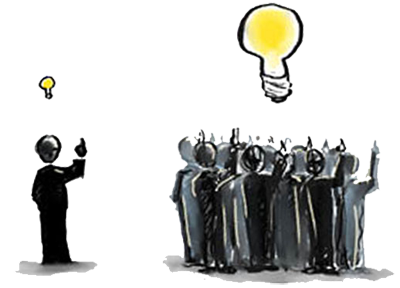 Creation of information is now in the hands of the individual. The technology has evolved so much that creation and sharing of the information is made easy especially through blogs and wikis.
The packaging of information: In recent years, the packaging of information has changed as well. Though not everyone creates content, everyone has interest to organize and package information. A student can create his version of the notes by aggregating the information from varied sources.
Validation of information: Aggregated actions of many are considered to be more effective than the actions of a selected few. Finding the required information in the network is one part; assessing the quality and timeliness of that information is the other. The faculty and students would develop an assessment framework to validate the information based on the quality, accessibility, structure, relevance and timeliness factors.
Wikipedia, the world's largest online encyclopedia stands as a great example of creation, packaging and validation of information by network of people.
Social e-learning is a powerful blend of Social networking and e-learning, which is transforming the traditional classroom education to an online collaborative platform for teaching, learning and improving the student's performance by shortening the time needed for mastering, increasing retention, and increasing engagement.
How does social e-learning platform work?
Social e-learning platform works to bridge students across campuses in a common platform.
Students using a social platform should be able
- to collaborate among the peers beyond institutional boundaries
- to analyze and improve their performance.
- to express themselves and form deep social connections with their institutions and friends.
The Social Learning has been in existence for more than a dozen years, yet its impact in terms of masses is still relatively low in comparison with other educational approaches.
In a social el-earning environment, when students get out of class, they have the opportunity to share their thoughts, experiences, and class notes with their peers, those in their classes as well as those who are not. Furthermore, faculty also has the chance to pose questions outside of class for students to think about: questions, which are also available to the public for responses and reflections. (http://www.socialfish.org/2011/08/what-can-social-learning-do-for-you.html)
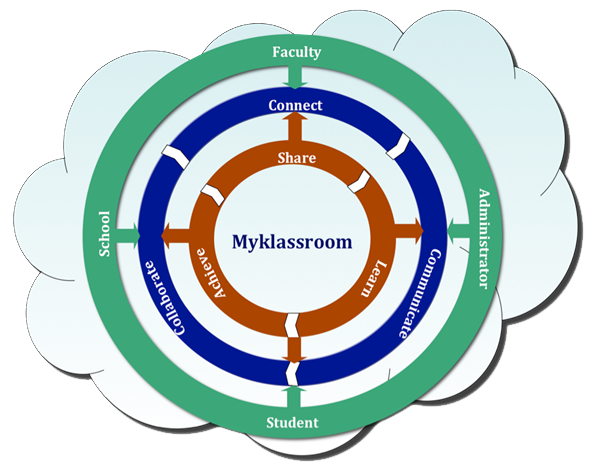
On the cloud based platform from Myklassroom.com, the main stakeholders like School, Faculty, Student and Administrators can leverage from the education network by Connecting, Communicating and Collaborating effectively. The virtual space provided by Myklassroom.com will integrate into your day-to-day life, the rich experience of learning, sharing and achieving the heights of success in every aspect on your academic career.
The beauty of social media as it pertains to social learning is that discussion is opened up to a broader audience outside of the classroom. Students and educators alike now have the ability to discuss what they are learning and teaching with a much wider community, and with that, we get a wider amount of people each having the potential to keep the conversation going by bringing their own unique perspective.

Power of peers
It's becoming increasingly clear that people's behavior is shaped by their peers.
Wisdom of the crowds
Online learning can be boring if not done right.

Analytics
Analytics and profiling helps us to better channelize our efforts and helps us to progress.
Our core
Keeping it simple
Technology needs to make a lives easier, we work hard to keep it simple and intitutive
Learning is fun when done together
Create your own learning space, invite your friends and learn with them. Engage with them in realtime.
Social notifications
Social notifications are a key part of our platform. Engaging the users with content is the most crucial part. Simple and subtle notifications are designed to engage our learners.